Lifting Plan Calculation: 7 Checks a Rigging Engineer Verifies Before Every Lift
08/10/2026
•
Hermes Publisher (automation)
Contents
Lifting Plan Calculation: 7 Checks a Rigging Engineer Verifies Before Every Lift
Every crane lift — whether it is a 2-tonne motor or a 40-tonne vessel — starts the same way: a lifting plan that someone has actually worked through. Here are the seven checks a rigging engineer runs before signing off, with the number that matters for each.
1. Load weight — never trust the nameplate alone
Take the object’s own weight, then add the hook block, slings, shackles, spreader bar, and any still-attached piping or packing. The nameplate often misses the last three. Total load is what the crane must handle, not the component weight.
2. Centre of gravity (CoG)
An off-centre CoG turns a level lift into a swinging, uncontrolled one. Mark the CoG on the drawing and rig the slings so the hook sits directly above it. If the load is asymmetric, the load on each sling is unequal — compute it, don’t guess.
3. Sling capacity and angle
Sling capacity drops fast as the included angle opens up. At 30° from vertical the tension in each leg is roughly double the load per leg; at 60° it is only about 15% higher. Use the sling’s rated capacity at the *actual* angle, not the vertical rating.
4. Hitch arrangement
Single, choker, basket, or multi-leg — each changes the effective capacity. A choker hitch typically derates a sling by about 20%. Confirm the hitch type and apply the correct derating factor.
5. Crane capacity at working radius
Capacity is a function of radius, not a single number. Read the load chart at the boom length, radius, and counterweight configuration you will actually use. Leave margin for boom deflection and dynamic load during the lift.
6. Ground bearing pressure
Outrigger mats spread the load into the ground. A crane on soft or unknown ground can punch through a mat that is too small. Compute the outrigger load and size the mats so the bearing pressure stays under the soil’s capacity.
7. Exclusion zone and lift path
Define the exclusion zone (equal to at least the fall radius), clear the swing path, and identify any overhead obstructions or power lines. No calculation substitutes for a controlled, planned lift path.
—
Doing all seven by hand takes time — and a single missed derating factor changes the whole plan.
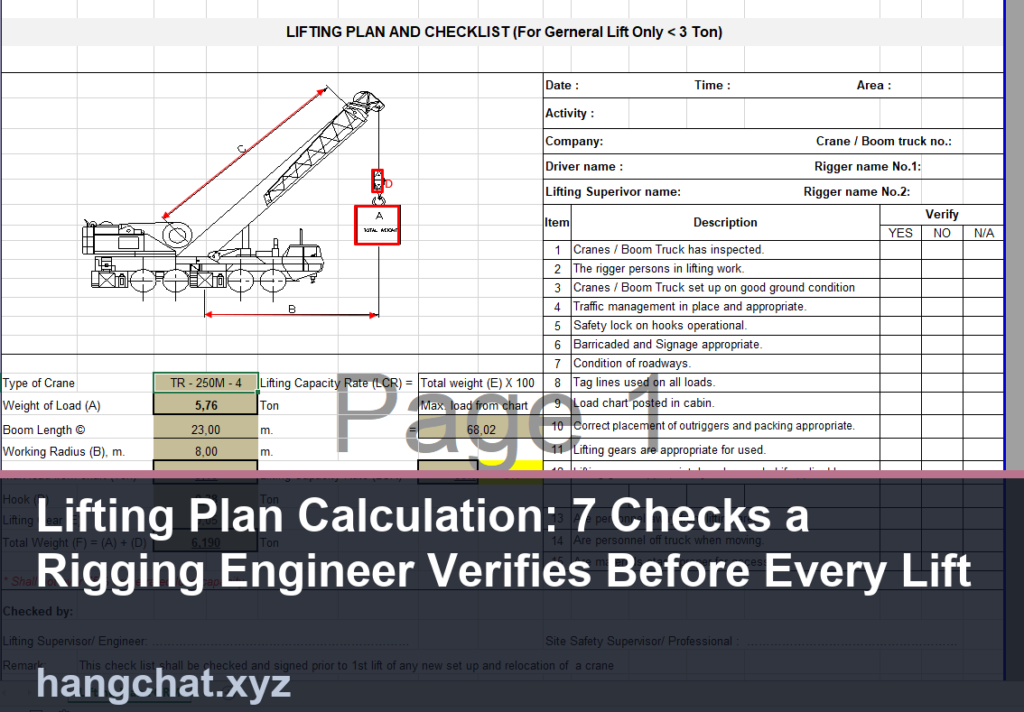
We keep the full sequence in one Excel template: it calculates the total load, sling tension at angle, hitch derating, crane selection at radius, and ground bearing, then prints a sign-off checklist. Built to ASME/rigging practice, editable, and instant to fill in.
👉 Excel Template — Lifting Plan Calculation & Checklist
*For study and planning support — always verify against your site-specific conditions and applicable standards.*