Spreadsheets
Excel Calculation Spreadsheet – Professional Pile Capacity Analysis – Complete Engineering Solution
9 $
What's Included
- Ready-to-use professional
Product Description
Comprehensive Geotechnical Analysis Tool for Foundation Design
Are you looking for aready-to-use, professional Excel toolfor pile foundation design? This comprehensive spreadsheet provides complete calculations for all critical aspects of pile capacity analysis.
What’s Inside:
1. Vertical Capacity Analysis
Ultimate End Bearing Resistance (Qb)– calculated using bearing capacity factors (Nc, Nq) based on soil friction angle and cohesion
Ultimate Skin Resistance (Qs)– layer-by-layer analysis with automatic summation across multiple soil strata
Safe Vertical Capacity (Qsafe)– applies user-defined factor of safety (FOS)
2. Tension Capacity Calculation
Ultimate and safe tension capacity using the 2/3 skin friction method
Self-weight consideration for accurate results
3. Horizontal (Lateral) Capacity
Elastic analysis based on pile head displacement
Considers pile material properties (Elastic modulus, Moment of inertia)
Accounts for fixed or free pile head conditions
4. Fixity Depth Analysis
Calculates pile fixity depth based on modulus of subgrade reaction
Relative stiffness factor (T) computation
Works for both sand and clay soils
5. Minimum Pile Length
Determines minimum required length for lateral capacity (flexible pile analysis)
Based on relative stiffness factor calculations
Key Features:
✅Detailed Soil Layer Input– Up to 10+ soil layers with individual parameters (cohesion, friction angle, unit weight, K-factor)
✅Comprehensive Pile Parameters:
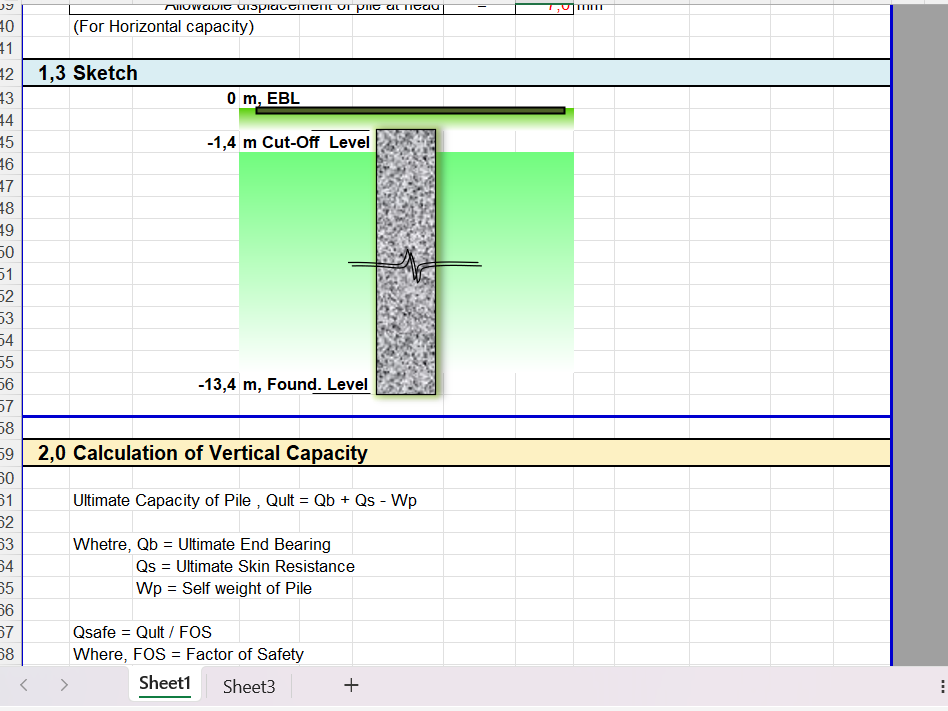
Pile diameter, length, cut-off level, founding level
Pile material properties (density, concrete grade)
Dredge and scour level considerations
✅Interaction Parameters– Coefficient of lateral earth pressure (K), angle of wall friction (δ), reduction factors (α)
✅Automatic Calculations:
Effective overburden pressure at each layer
Surface area of pile in each soil layer
Self-weight deduction from ultimate capacity
✅Reference Tables Included– Bearing capacity factor (Nq) values for angles from 0° to 40° for bored cast-in-situ piles
✅Summary Sheet– Quick overview of all critical results including safe capacities, fixity depth, and pile geometry
Calculation Methodology:
The spreadsheet followsindustry-standard static analysis methods:
Ultimate Capacity Formula:
Qult=Qb+Qs−Wp
Where:
Qb= Ultimate End Bearing =(c×Nc+Pd×Nq)×Ap
Qs= Ultimate Skin Resistance =∑(a×c+K×Pd×tanδ)×As
Wp= Self weight of pile
Safe Capacity:
Qsafe=Qult/FOS
Who Should Use This?
👷Geotechnical Engineers– Quick pile capacity verification for various soil profiles
🏢Structural Engineers– Foundation design for buildings, bridges, and waterfront structures
📋Design Consultants– Client deliverables with detailed calculation sheets
🎓Students & Researchers– Learning tool for understanding pile foundation behavior
Example Calculation Included:
The spreadsheet comes with aworked example:
400mm diameter bored pile
12m embedment length through 4 different soil layers
Results: Safe vertical capacity = 429.79 kN, Tension capacity = 202.93 kN, Horizontal capacity = 73.95 kN (at 7mm displacement)
Why Choose This Spreadsheet?
💰Cost-Effective– No expensive software licenses required
⚡Instant Results– All calculations update automatically when input parameters change
📊Transparent Calculations– Every step shown clearly for verification and learning
🔧Customizable– Easy to modify for project-specific requirements
📱Compatible– Works with Microsoft Excel (no special plugins needed)
Perfect For:
Preliminary design and feasibility studies
Design optimization (comparing different pile diameters and lengths)
Checking contractor submittals
Quick capacity estimates during site investigations
Technical Standards:
Calculations align with established geotechnical engineering principles and can be adapted for various international codes.
Technical Specifications
Q: What pile types can be analyzed with this spreadsheet?
A: The spreadsheet is specifically configured for bored cast-in-situ piles but can be adapted for driven piles by adjusting the bearing capacity factors.
Q: How many soil layers can I input?
A: The spreadsheet supports multiple soil layers (up to 10+ layers), each with unique geotechnical parameters including cohesion, friction angle, unit weight, and K-factor.
Q: What pile diameter range is supported?
A: The spreadsheet can handle any pile diameter. The included example uses a 400mm diameter pile, but you can input any size.
Q: Can I calculate pile group capacity?
A: This version focuses on single pile capacity calculations. For pile group analysis, you would need to apply efficiency factors and group behavior methods separately.
Calculation Methods
Q: What is the difference between end bearing and skin friction?
A: End bearing (Qb) is the load carried by the pile tip resting on strong soil or rock, calculated using bearing capacity factors. Skin friction (Qs) is the resistance developed along the pile shaft through friction with surrounding soil layers.
Q: How is ultimate pile capacity calculated?
A: Ultimate capacity uses the formula:Qult = Qb + Qs – Wp, where Qb is end bearing resistance, Qs is total skin friction resistance, and Wp is the self-weight of the pile.
Q: What is the safe pile capacity?
A: Safe capacity is calculated by dividing the ultimate capacity by a factor of safety (typically 2.5 to 3.0):Qsafe = Qult / FOS.
Q: How is tension capacity different from compression capacity?
A: Tension capacity uses only 2/3 of the skin friction plus the pile self-weight:Qult(T) = 2/3 × Qs + Wp. This accounts for reduced soil adhesion under uplift forces.
Q: What is horizontal (lateral) capacity?
A: Horizontal capacity is the pile’s ability to resist lateral loads, calculated using elastic analysis based on pile stiffness, soil modulus of subgrade reaction, and allowable displacement at the pile head.
Input Parameters
Q: What soil parameters do I need to provide?
A: For each soil layer, you need: cohesion (c), friction angle (φ), unit weight (γ), coefficient of lateral earth pressure (K), and angle of wall friction (δ).
Q: What is the coefficient of lateral earth pressure (K)?
A: K represents the ratio of horizontal to vertical soil stress and affects skin friction calculations. Typical values range from 0.5 to 2.0 depending on soil type and installation method.
Q: What are bearing capacity factors (Nc, Nq)?
A: These are dimensionless factors that depend on the soil’s friction angle and are used to calculate end bearing capacity. The spreadsheet includes reference tables with standard Nq values for angles from 0° to 40°.
Q: What is the reduction factor (α)?
A: The adhesion reduction factor (α) accounts for reduced bond between pile and cohesive soil, typically ranging from 0.3 to 1.0. For purely frictional soils, α = 0.
Q: Do I need to consider groundwater levels?
A: Yes, groundwater affects soil unit weight (use submerged unit weight below water table) and effective stress calculations, which significantly impact pile capacity.
Related Products
Spreadsheets
-53%
Excel Template - Lifting Plan calculation and check list
Original price was: 19 $.9 $Current price is: 9 $.

Spreadsheets

Spreadsheets

Spreadsheets