A Comparative Analysis of Eurocode 3 and AISC 360 Steel Design Standards
02/12/2023
•
hangchat
Contents
AISC 360 & Eurocode 3
Each code has its strengths and is designed to meet the specific needs and practices of its respective region. The choice between them often depends on the project’s location, the engineer’s familiarity with the code, and specific project requirements.
AISC 360 Code
- Design Philosophy: AISC adopts the Load and Resistance Factor Design (LRFD) and the Allowable Strength Design (ASD) methods. LRFD is more commonly used in recent years.
- Safety Factors: It uses different factors of safety for LRFD and ASD. LRFD applies load factors and resistance factors, while ASD uses safety factors on stress.
- Force Calculation: Emphasizes on the balance between dead loads, live loads, environmental loads, and the strength of the materials.
- Advantages:
- Familiarity and Preference in the U.S.: It’s well-established and widely used in the U.S.
- Flexibility: Offers two design methods (LRFD and ASD).
- Disadvantages:
- Regional Limitation: Primarily tailored to U.S. practices and standards, less adapted to international contexts.
- Complexity in Some Areas: Certain aspects, like seismic design, can be more complex.
Eurocode 3
- Design Philosophy: Eurocode 3 uses Limit State Design (LSD) focusing on the ultimate and serviceability limit states.
- Safety Factors: Applies partial safety factors for both loads and material strengths, tailored to various load combinations and types.
- Force Calculation: Considers a wide range of loads and factors, with a particular emphasis on the European climate and construction practices.
- Advantages:
- Harmonization Across Europe: Creates a standard applicable across multiple countries, facilitating international projects.
- Comprehensive Coverage: Covers a broad range of structures and loading conditions, including unusual loads.
- Disadvantages:
- Complexity for Non-European Contexts: Can be complex to apply in non-European countries due to its specific focus.
- Steep Learning Curve: The breadth and depth of the codes can be overwhelming for new users.
Comparative Table
| Aspect | AISC 360 Code | Eurocode 3 |
|---|---|---|
| Design Philosophy | LRFD and ASD | Limit State Design (LSD) |
| Safety Factors | Different for LRFD and ASD | Uniform partial safety factors |
| Force Calculation | Balances various loads and strength | Wide range of loads, European focus |
| Material | In the United States, structural steel material should conform to the standards set forth by the American Society for Testing and Materials (ASTM). Widely used structural steels are A36 (Fy=248 MPa (36 ksi), Fu=400 MPa (58 ksi)), and A572 Gr50 or A992 (Fy=345 MPa (50 ksi), Fu=448 MPa (65 ksi)). | In Europe, structural steel material properties are documented in Euronorm EN 10025 (1994). Widely used structural steels are S235 (Fy=235 MPa (34 ksi), Fu=360 MPa (52 ksi)), S275 (Fy=275 MPa (40 ksi), Fu=430 MPa (62 ksi)), and S355 (Fy=355 MPa (51 ksi), Fu=510 MPa (74 Ksi) |
| Advantages | Familiar in U.S., flexibility | Harmonization, comprehensive coverage |
| Disadvantages | U.S.-centric, some complex areas | Complex in non-European contexts |
| Excel Spreadsheets calculation Download | Design for steel Spreadsheets According to AISC 360 Code | Design for steel Spreadsheets According to Eurocode 3 |
Some key differences in a table format focusing on the major design aspects:
| Aspect | AISC 360 | Eurocode 3 |
|---|---|---|
| Member Design | Different equations for various buckling modes | Unified approach with reduction factors |
| Lateral Torsional Buckling | Employs Lp, Lr for determining buckling capacity | Uses reduction factor (χLT) based on slenderness |
| Shear Design of Members | Two methods for calculating shear strength | Single method with detailed parameters |
| Welded Connections | AWS provisions adopted, considers electrode strength | Weld metal strength equivalent or better than base metal |
| Bolted Connections | Specific provisions for high-strength bolts, pre-tension requirements | Design categories based on bolt types and connection details |
| Combined Actions in Bolts | Multiple equations, including an elliptical expression | Single equation for assessment |
| Bearing Strength at Bolt Holes | Separate rules for deformation consideration | More elaborate treatment considering hole tear-out and excessive elongation |
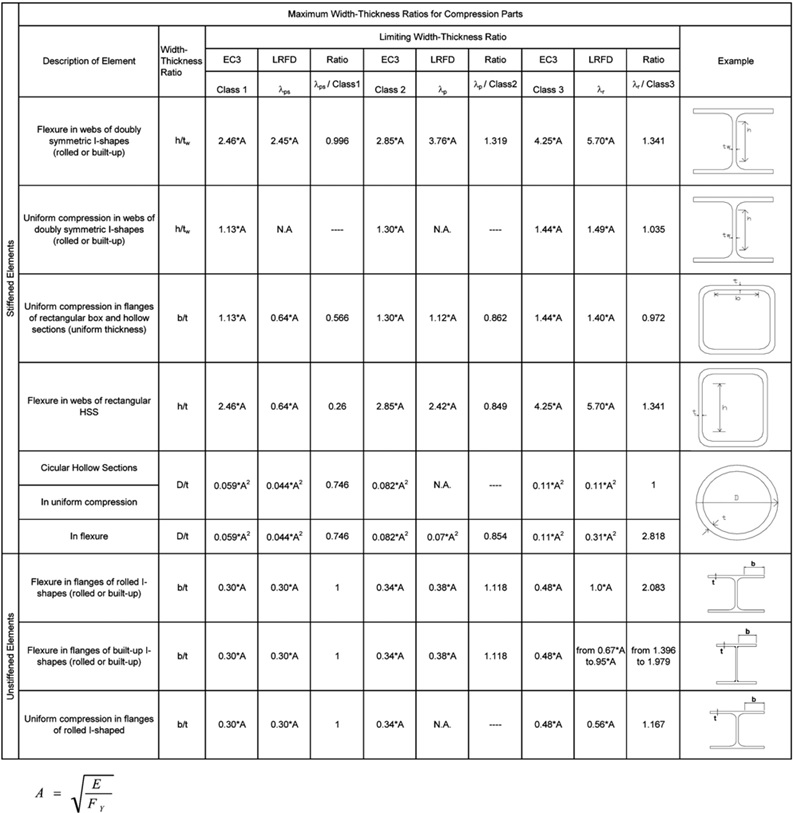
Maximum Width Thickness Ratio for compression part AISC 360 And Eurocode 360
Summary
- AISC 360 Code is more tailored to U.S. practices with flexibility in design methods but can be complex in certain areas.
- Eurocode 3 provides a harmonized approach across Europe, covering a wide range of structures and loading conditions, but might be complex for non-European applications.
Download Research Full PDF file:
[gget id=”1″ url=”https://drive.google.com/file/d/1QPqkEBExpmoF8GrJx01uq_lByeafnz8m/view?usp=sharing”]